
How to Plan a Commercial Landscape Renovation Without Disrupting Operations
Renovating commercial grounds while the property stays open takes planning. Here is how to phase the work so your business keeps running while the landscape gets upgraded.
Key Takeaways
- A landscape renovation on an active property is phased, not done all at once. The plan protects the business while the work happens.
- Sequence the work by priority and by impact. High-visibility areas first, low-traffic areas during off hours, and entrances during slow periods.
- Communicate the plan to tenants, guests, and visitors before the work starts, not after the fences go up.
- Build a contingency into the schedule for weather, deliveries, and the surprises that come with any renovation on an occupied site.
How to Plan a Commercial Landscape Renovation Without Disrupting Operations?
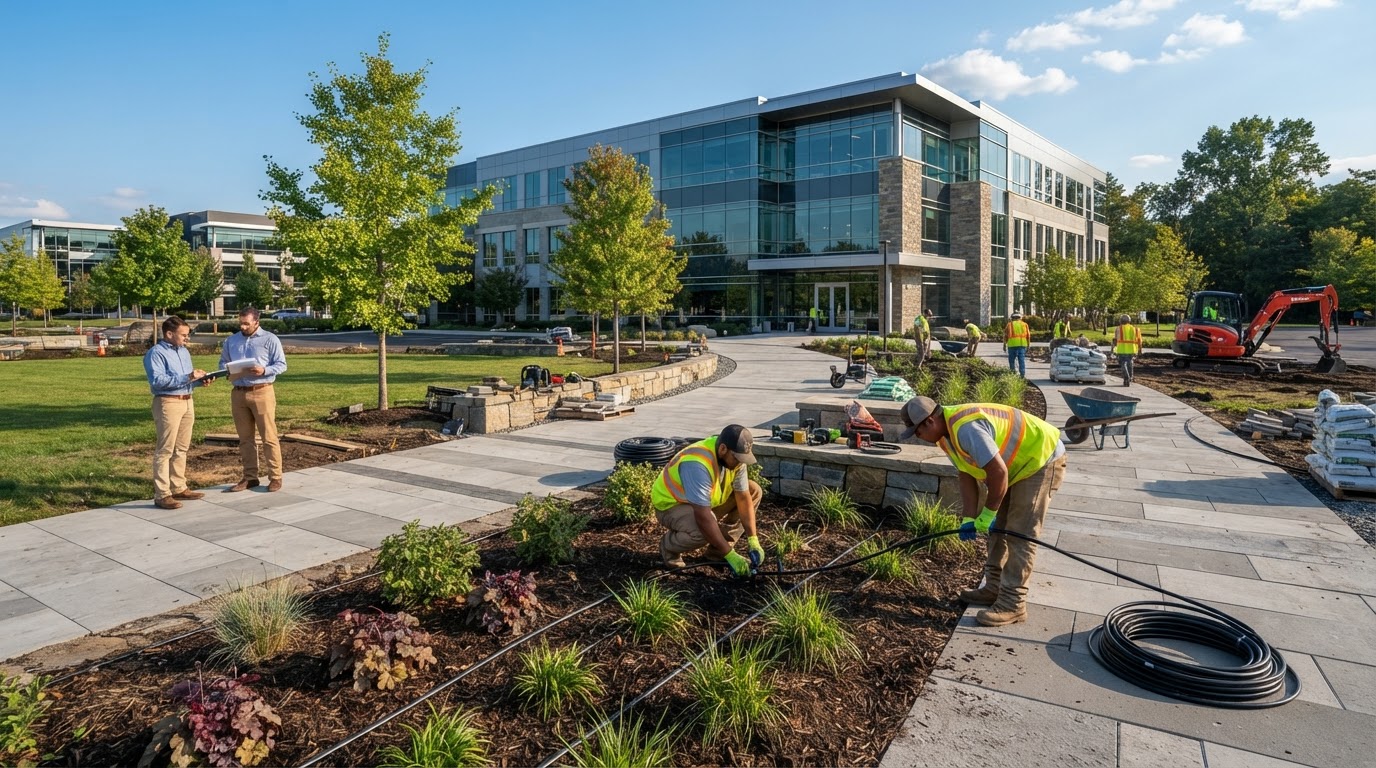
A commercial landscape renovation on an occupied property is a different project than one on an empty lot. The building is open, the parking lot is full, the entrance is in use, and the people who use the property every day need to keep using it. The renovation has to happen around them, not through them.
Planning the renovation well means phasing the work so the property stays functional while the landscape gets upgraded. It means sequencing the construction so the most visible work happens first, the most disruptive work happens during off hours, and the entrances never close.
What Does Phasing Mean for a Landscape Renovation?
Phasing means breaking the renovation into stages, each with its own scope, schedule, and impact on the property. Instead of tearing up the entire landscape at once, you renovate one area at a time. While one area is under construction, the rest of the property stays open and functional.
The phases are usually defined by area: the entrance and arrival sequence, the parking lot islands, the building perimeter, the common areas, and any specialized zones like courtyards or patios. Each phase has a start date, a duration, and a plan for how the area is accessed during construction.
How Do You Sequence the Work?
Start with the entrance and the arrival sequence. That is the first impression. Do it first so the renovation starts with a visible upgrade, not a visible disruption. Then move to the parking lot islands and the building perimeter. Save the interior courtyards and common areas for last, when the exterior is already looking good.
Within each phase, sequence the work so the most disruptive parts happen during the property's slowest hours. For an office campus, that means weekends and early mornings. For a hotel, it means the off-season or the middle of the week. For a retail center, it means before opening or after closing.
How Do You Keep the Entrance Open During Construction?
The entrance is the hardest area to renovate because it cannot close. Plan the entrance work in two stages. Stage one is the hardscape: the walk, the entry pad, any new signage pads. Do this work in sections, with a temporary walkway routed around the construction zone.
Stage two is the planting and the finishing: the beds, the lighting, the seasonal color. This goes in after the hardscape is done and the area is safe to walk through. The result is that the entrance is never closed, just partially under construction at any given time.
How Do You Communicate the Plan to Tenants and Visitors?
Before the first fence goes up, send a notice to every tenant, every resident, and every department that uses the property. Tell them what is happening, when it is happening, where the temporary paths are, and how long each phase will last. Update them at each phase transition.
For a hotel, put a note at check-in and in the rooms. For an office campus, email the tenants and post signs at the entrances. For an HOA, post the notice at the mailboxes and in the community portal. People tolerate construction when they know what to expect.
What About Safety and Access During Construction?
Every construction zone needs temporary fencing, signage, and a safe alternate path. The fence keeps people out of the work area. The signage tells them where to go. The alternate path keeps the property accessible.
Plan the temporary paths to be accessible, meaning wide enough for a wheelchair, a stroller, or a delivery cart. If the construction blocks a ADA-compliant path, the temporary path must also be ADA-compliant. This is not optional. It is the law.
How Do You Handle Irrigation and Utilities During the Renovation?
The irrigation system is often the first thing that has to be modified during a landscape renovation, because the new planting layout means new zones, new heads, and new pipe runs. Plan the irrigation work as the first step of each phase, before the planting goes in.
Utilities like electrical for lighting and water for irrigation need to be coordinated with the renovation schedule. If the new lighting requires a new transformer or a new circuit, plan the electrical work before the hardscape goes in so you do not have to trench through a finished patio.
How Long Does a Commercial Landscape Renovation Take?
The timeline depends on the property size, the scope, and the number of phases. A small entrance renovation might take two to four weeks. A full property renovation might take three to six months, phased so the property stays open throughout.
Build a contingency into the schedule. Weather, deliveries, and the surprises that come with any renovation on an occupied site will extend the timeline. A 10 to 15 percent contingency on the schedule is standard for a phased commercial renovation.
Frequently Asked Questions
Can we stay open during a landscape renovation?
Yes, if the renovation is phased. Each construction zone is fenced and routed around, and the rest of the property stays open. The key is sequencing the work so the most disruptive parts happen during your slowest hours.
How much of the property is under construction at once?
Usually no more than 20 to 30 percent at any given time. That keeps the property functional and the disruption manageable. If you need to do more at once, plan it for a period when the property is least busy.
Do we need to notify tenants before the renovation starts?
Yes. Send a notice before the first fence goes up, and update at each phase transition. People tolerate construction when they know what to expect. Surprise fences and blocked paths cause complaints.
What happens if the renovation runs over schedule?
Build a 10 to 15 percent contingency into the schedule from the start. If the renovation runs over, the contingency absorbs it. If it does not, you finish early. Either way, communicate the updated timeline as soon as you know it.
Should we renovate the irrigation system at the same time?
Yes, if the new planting layout changes the zones. Plan the irrigation work as the first step of each phase, before the planting goes in. Modifying irrigation after the planting is installed costs more and damages the new plants.
Keep Reading
Plan your project
Use the Project Planner to get a plan outline for your project type, with steps and questions to ask.
Start Your Plan