
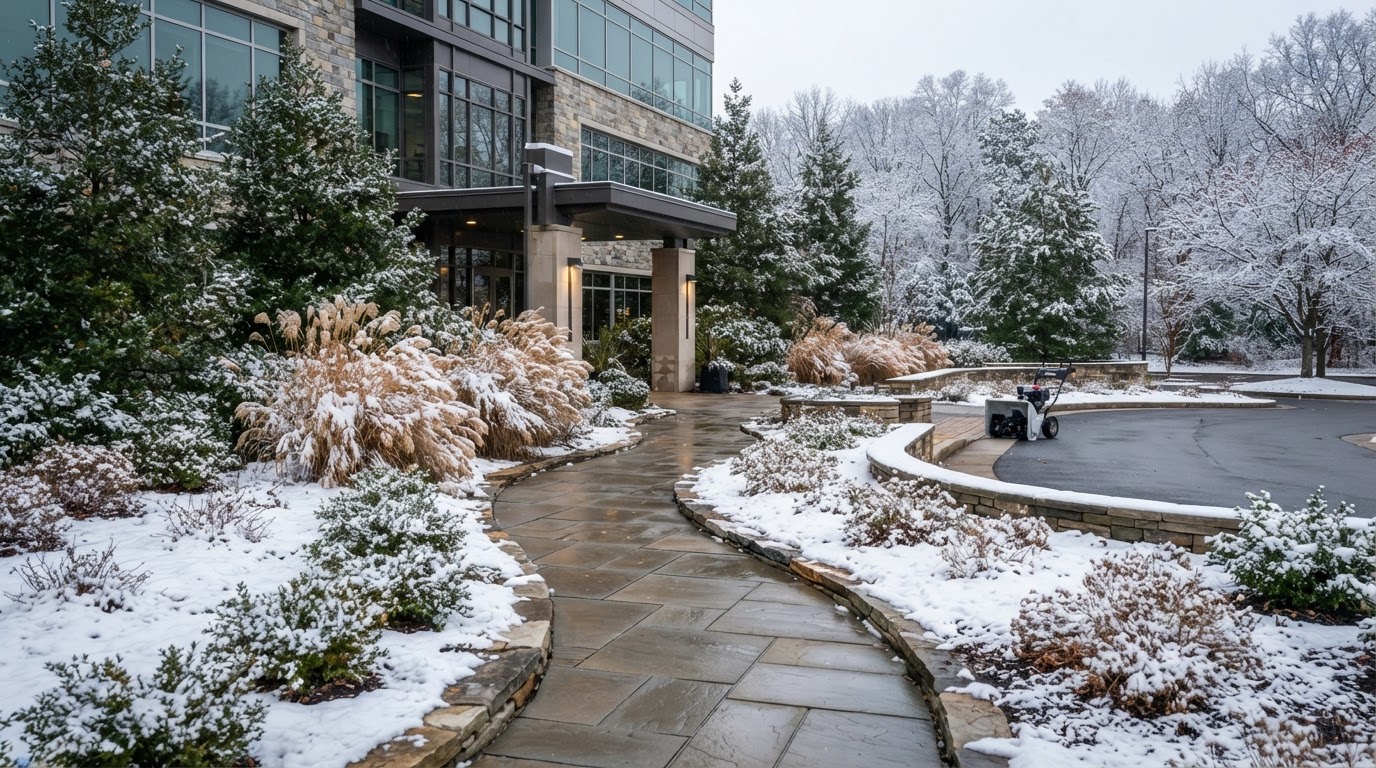
How to Prepare Your Commercial Grounds for Winter Without Losing Your Investment
Winter kills plants and destroys hardscape if you do not prepare. Here is a step-by-step plan for shutting down your commercial grounds so they survive the cold and come back strong in spring.
Key Takeaways
- Winter preparation is the work that determines whether your landscape survives the cold or arrives damaged in spring. The investment in fall saves the cost of replacement in spring.
- The three priorities are irrigation shutdown, plant protection, and hardscape protection. Each one prevents a specific type of winter damage that costs far more to fix than to prevent.
- A winterization checklist is the document that ensures nothing is missed. The property that is winterized systematically is the property that comes through winter intact.
- Snow and ice management is a liability issue, not just a maintenance issue. The plan for snow removal and ice mitigation is the plan that protects the property and the people on it.
How to Prepare Commercial Grounds for Winter?
Winter is the season that tests every commercial landscape, and the preparation you do in the fall is the preparation that determines whether the property arrives in spring healthy or damaged. A commercial property has more at stake than a residential one, because the damage is not just to the plants. It is the liability from icy walks, the cost of replacing dead landscaping, and the lost curb appeal that affects tenant perception and lease renewals. Winter preparation is not a task. It is a system, and the property that is prepared systematically is the property that survives the winter without the costly surprises that eat the maintenance budget.
The preparation comes down to four areas: irrigation, plants, hardscape, and snow management. Each area has its own risks and its own timeline, and the timeline is set by the first hard frost, not by the calendar. The property that is winterized before the first frost is the property that is protected. The property that is winterized after the first frost is the property that is already damaged.
How Do You Shut Down and Winterize the Irrigation System?
The irrigation system is the first priority, because a system that freezes is a system that cracks, and a cracked line is a line that floods the property or the building in the spring. The shutdown is not just turning off the water. It is draining the lines, blowing out the heads, and protecting the backflow preventer. A professional winterization uses compressed air to clear the lines, because water left in a line under a head or a valve will freeze and split the pipe.
The backflow preventer is the device that keeps irrigation water out of the drinking water supply, and it is the part that freezes most easily. It needs to be drained, insulated, or brought inside, depending on the type and the climate. The system that is winterized by a professional is the system that starts up clean in the spring. The system that is winterized by turning off the water is the system that floods in the spring, and the flood is the one that costs thousands to dollars in repairs.
How Do You Protect Plants from Winter Damage?
Plant protection is the second priority, and the protection depends on the plant and the climate. Tender plants that are not cold-hardy need to be wrapped, mulched, or moved inside before the first hard freeze. Evergreens that are exposed to wind need anti-desiccant spray or burlap screens to prevent the winter burn that turns the foliage brown. Newly planted trees and shrubs need extra mulch and water before the ground freezes, because their root systems are not established enough to handle the freeze-thaw cycle.
The most common winter damage is not from the cold. It is from the freeze-thaw cycle, where the ground freezes and thaws repeatedly, which heaves the roots and splits the bark. A layer of mulch over the root zone stabilizes the soil temperature and prevents the heaving. The mulch should be two to three inches deep and pulled back from the trunk, because mulch against the trunk is where mice and voles nest and chew the bark, which girdles and kills the tree.
How Do You Protect Hardscape from Winter Damage?
Hardscape protection is the third priority, and it is the one most often skipped. Pavers, stone, and concrete can be damaged by ice melt products, and the wrong product will pit the surface, stain the stone, and degrade the joints. Use calcium chloride or a proprietary ice melt that is labeled safe for the surface, and avoid rock salt, which is the cheapest and the most damaging. The damage from rock salt does not show up until spring, when the pavers start to flake and the stone starts to pit, and the repair is far more expensive than the ice melt that would have prevented it.
Drainage is the other hardscape risk. Water that pools on a surface and freezes will expand and crack the surface, whether it is concrete, stone, or pavers. Walk the property before winter and fix any low spots, clogged drains, or settled areas where water will pool. A surface that drains before winter is a surface that does not crack during winter, because the water that drains does not freeze and expand.
How Do You Plan for Snow and Ice Management?
Snow and ice management is the fourth priority, and it is the one that carries the most liability. A commercial property has a duty to keep walks, drives, and parking areas safe, and the plan for snow removal is the plan that fulfills that duty. The plan is not just a shovel and a bag of salt. It is a contract with a snow removal company, a priority order for which areas are cleared first, and a trigger for when the company is called. The plan that is in place before the first snow is the plan that keeps the property safe and the liability low.
The ice mitigation plan is the second half of snow management. Ice forms when snow melts and refreezes, and the ice is the hazard that causes the falls. Pre-treat walks and drives with ice melt before the storm, because the ice melt that goes down before the snow is the ice melt that prevents the ice from forming. The pre-treatment is not a guarantee, but it is the difference between a surface that is manageable and a surface that is a sheet of ice that no amount of salt will fix.
How Do You Build a Winterization Checklist?
A winterization checklist is the document that ensures nothing is missed, and it is the document that is built from the history of what has gone wrong on the property in past winters. The checklist covers irrigation shutdown, plant protection, hardscape protection, snow and ice management, and the inspection that confirms each one is done. The property that is winterized with a checklist is the property that is winterized completely. The property that is winterized from memory is the property that misses the one thing that costs the most to fix.
The checklist is built in the fall and used in the fall, and it is updated every year with the lessons from the previous winter. The property that has a winterization checklist is the property that improves its winter preparation every year, and the improvement is what lowers the cost of winter damage over time. The property that does not have a checklist is the property that repeats the same damage every winter and pays for it every spring.
Frequently Asked Questions
When should commercial winter preparation start?
Commercial winter preparation should start in early fall, six to eight weeks before the first expected hard frost. because the irrigation shutdown, plant protection, and snow contracts all need lead time. The preparation that starts after the first frost is the preparation that is too late for the plants and the irrigation system, because the damage from the first freeze is the damage that the preparation was meant to prevent. Start early, work from a checklist, and finish before the frost, because the frost does not wait for the preparation to be done.
How much does commercial winter preparation cost?
The cost depends on the property size, the scope of the winterization, and whether the work is done in-house or by a contractor. Irrigation winterization is the most specialized and is best done by a professional. Plant protection and hardscape protection can be done by the maintenance crew. Snow and ice management is a contracted service with a seasonal cost. The total cost is a fraction of the cost of the damage it prevents, because a cracked irrigation line, a dead tree, or a slip-and-fall claim each cost more than the entire winter preparation.
Can I use rock salt on commercial walkways and parking?
Rock salt is the cheapest ice melt but also the most damaging. It pits concrete, stains stone, degrades paver joints, and kills nearby plants and lawns. On a commercial property, the cost of the damage from rock salt is far higher than the savings on the product. Use calcium chloride or a proprietary ice melt labeled safe for the surface, and apply it before the storm, not after. The pre-treatment prevents the ice from bonding to the surface, which means less product and less damage.
What happens if I do not winterize the irrigation system?
An irrigation system that is not winterized will freeze, and the water left in the lines, valves, and heads will expand and crack them. In the spring, the cracked lines flood the property, the broken heads need replacement, and the backflow preventer may fail inspection. The cost of the repair is typically thousands of dollars, and the cost of the water damage from a flooded line can be far more. A professional winterization costs a fraction of the repair it prevents, which is why it is the single highest-return winter task.
How do I protect newly planted trees for winter?
Newly planted trees are the most vulnerable to winter damage because their root systems are not established. Water them deeply before the ground freezes, apply two to three inches of mulch over the root zone, and wrap the trunk with a tree guard to prevent sun scald and animal damage. Do not wrap the entire tree, because the wrap can trap moisture and promote disease. The goal is to protect the roots and the trunk, not to seal the tree in a wrap that causes its own problems.
Keep Reading

Plan your project
Use the Project Planner to get a plan outline for your project type, with steps and questions to ask.
Start Your Plan