
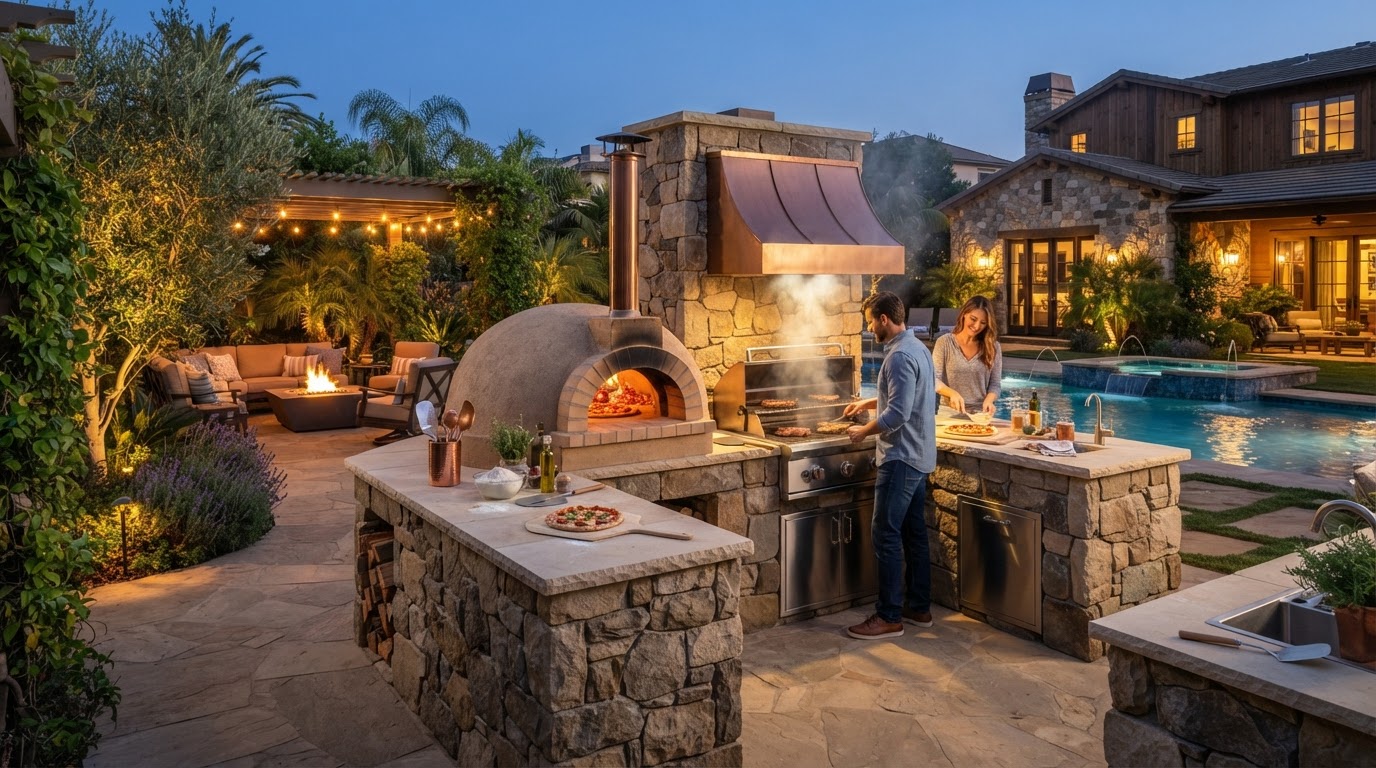
How to Build an Outdoor Pizza Oven and Grill Station That Lasts
An outdoor pizza oven and grill station is a masonry structure that holds heat for decades or falls apart in three years. Here is how to plan the base, the structure, and the ventilation so it cooks like it should and lasts like it should.
Key Takeaways
- The base carries the oven for decades or fails in three years. A reinforced concrete base on a proper footing is non-negotiable.
- Firebrick and refractory mortar handle the heat. Standard brick and regular mortar crack and spall under repeated firing.
- Ventilation above the oven and clearance from combustibles are code, not preferences. Skip them and the structure is unsafe.
- A roof or cover over the station protects the masonry and the appliances. An uncovered station weathers and degrades faster.
How to Build an Outdoor Pizza Oven and Grill Station That Lasts?
An outdoor pizza oven and grill station is a masonry structure built to hold extreme heat, support heavy appliances, and stand outside in the weather for decades. It is not a kit you bolt together. The base, the structure, the materials, and the ventilation all determine whether it cooks well and lasts or cracks and fails within a few seasons. Building it well means planning the structure before you pick the oven.
The most common failure is not the oven. It is the base. A base built without a proper footing settles unevenly, and the masonry above it cracks. A base built with the wrong materials spalls and crumbles under the heat. The oven is the part you see. The base and the structure are the parts that decide whether you are rebuilding in five years or enjoying it in fifteen.
How Do You Build the Base?
The base is a reinforced concrete block or poured concrete structure on a footing that extends below the frost line. The footing prevents frost heave from cracking the masonry. Without it, the base shifts with every freeze-thaw cycle, and the oven above it cracks along the joints. The footing is the part you cannot see and the part that matters most.
Build the base from concrete block, reinforced with rebar and filled with concrete, or from poured concrete. The top of the base should be a reinforced concrete slab thick enough to carry the weight of the oven, which can be several hundred pounds. Do not build the base from wood, brick, or dry-stacked block. Wood burns. Brick and dry-stacked block lack the strength and the reinforcement to carry the load without cracking.
What Materials Handle the Heat?
The interior of the oven, the floor, and the dome are built from firebrick and refractory mortar. Firebrick is rated for the temperatures a wood-fired oven reaches, which can exceed 900 degrees. Standard brick is not. It cracks, spalls, and eventually fails under repeated firing. Refractory mortar is designed for high heat. Standard mortar breaks down and turns to powder.
The oven floor is the cooking surface. It should be firebrick laid tight, with minimal joints, so the dough cooks on a smooth, even surface. The dome is the heat-holding structure. It can be brick, cast refractory, or a prefabricated dome. Each has trade-offs in cost, build time, and performance, but all must be rated for the heat. The wrong material in the oven is the difference between a pizza oven and a fire hazard.
How Do You Handle Ventilation and Clearance?
Ventilation is a safety requirement, not a preference. The chimney or vent above the oven carries smoke and heat away from the cooking area and the structure. A vent that is too small or poorly placed draws poorly and pushes smoke into the cook's face. A vent that is missing is a fire hazard. Plan the vent before you build the structure, because retrofitting one is expensive and often ugly.
Clearance from combustibles is code. The oven and the chimney must be a minimum distance from any wood structure, including the roof of a cover, the siding of the house, and overhead framing. The exact distance depends on the oven and the local code, but the principle is the same: heat radiates, and combustibles near the oven will eventually ignite. Non-combustible materials between the oven and any wood, plus the right clearance, are what keep the station safe.
How Do You Integrate the Grill and Counter?
The grill and the counter are part of the same structure, and they need to be planned together. The grill drops into a cutout in the counter, so the counter material has to be rated for the heat and the weight. Granite, concrete, and stone are common. Wood and composite are not, because they burn and warp near the heat.
The counter should slope slightly for drainage, because a flat outdoor counter holds water and stains. The grill cutout should be measured from the manufacturer's specs, not estimated, because a cutout that is too big lets the grill drop and a cutout that is too small does not fit. Plan the counter height for the cook, not for the structure. A counter at the wrong height makes the station uncomfortable to use, and an uncomfortable station does not get used.
How Do You Protect the Station From Weather?
A roof or cover over the station protects the masonry, the appliances, and the cook. An uncovered station weathers. The masonry absorbs water, freezes, and spalls. The grill rusts. The cook stands in the rain. A cover does not have to be a full roof, but it should shed water and provide shade.
The cover structure must be non-combustible near the oven and chimney, with the right clearance. A wood cover too close to the chimney is a fire hazard. A metal or masonry cover with the right clearance is safe and durable. The cover is also where lighting and power get integrated, so plan the wiring before the cover goes up. A station with a cover, lighting, and power is a station that gets used at night and in the rain, which is the difference between an investment and a decoration.
How Do You Maintain an Outdoor Pizza Oven and Grill Station?
Maintenance is light but regular. Sweep the oven floor after each use to remove ash and debris. Inspect the dome and the mortar joints annually for cracks, and patch them with refractory mortar before they grow. Cover the grill when not in use to prevent rust. Clean the counter with mild soap, not acid, because acid etches stone and concrete.
The base and the structure need no maintenance if they were built right. The appliances need the maintenance the manufacturer specifies. The cover needs inspection for leaks and structural integrity. A station that is maintained lasts decades. A station that is ignored develops cracks, rust, and water damage that shorten its life by years. The maintenance is minimal, but it has to happen.
Frequently Asked Questions
How much does an outdoor pizza oven and grill station cost?
The cost varies widely based on size, materials, the oven type, and the appliances. The base and the masonry are the largest cost drivers. A small simple station costs far less than a large station with a wood-fired oven, a built-in grill, a refrigerator, and a cover. Plan the budget around the structure, not just the appliances.
Can I build a pizza oven on a wood deck?
No. A pizza oven weighs hundreds of pounds and reaches extreme temperatures. A wood deck cannot support the weight safely and is a fire hazard. The base must be masonry on a proper footing, separated from any wood structure by the right clearance.
How long does it take to build an outdoor pizza oven and grill station?
A custom masonry station takes several weeks of construction, plus curing time for the oven. The base, the structure, the oven, the counter, and the cover are sequential steps. A prefabricated oven on a simpler base is faster but still requires a proper footing and structure.
Do I need a permit for an outdoor pizza oven?
In most areas, yes. A permanent masonry structure with a fire feature and a chimney typically requires a permit and an inspection. Check with your local building department before you start, because the clearance and ventilation requirements are code, not preferences.
What is the difference between a wood-fired and gas pizza oven?
A wood-fired oven reaches higher temperatures and imparts a smoke flavor, but it requires more skill and time to manage the fire. A gas oven is easier to control and faster to start, but it does not reach the same temperatures or flavor. Some ovens are hybrid, using gas for convenience and wood for flavor.
Keep Reading


Plan your project
Use the Project Planner to get a plan outline for your project type, with steps and questions to ask.
Start Your Plan