
How to Design a Backyard Lighting Plan That Works After Dark
A backyard that looks great in the daytime disappears at night without the right lighting. Here is how to design a lighting plan in layers that make your yard usable and beautiful after dark.
Key Takeaways
- Design backyard lighting in layers: path lighting for safety, ambient lighting for mood, and accent lighting for features.
- Less is more. Light the key features and leave the rest in low light. Over-lighting kills the mood and wastes energy.
- Use warm white LEDs, 2700K to 3000K, for a natural look. Cool white looks institutional and harsh.
- Plan the lighting alongside the landscape, not after. Wiring runs are easier and cheaper before plants and hardscape go in.
How to Design a Backyard Lighting Plan That Works After Dark?
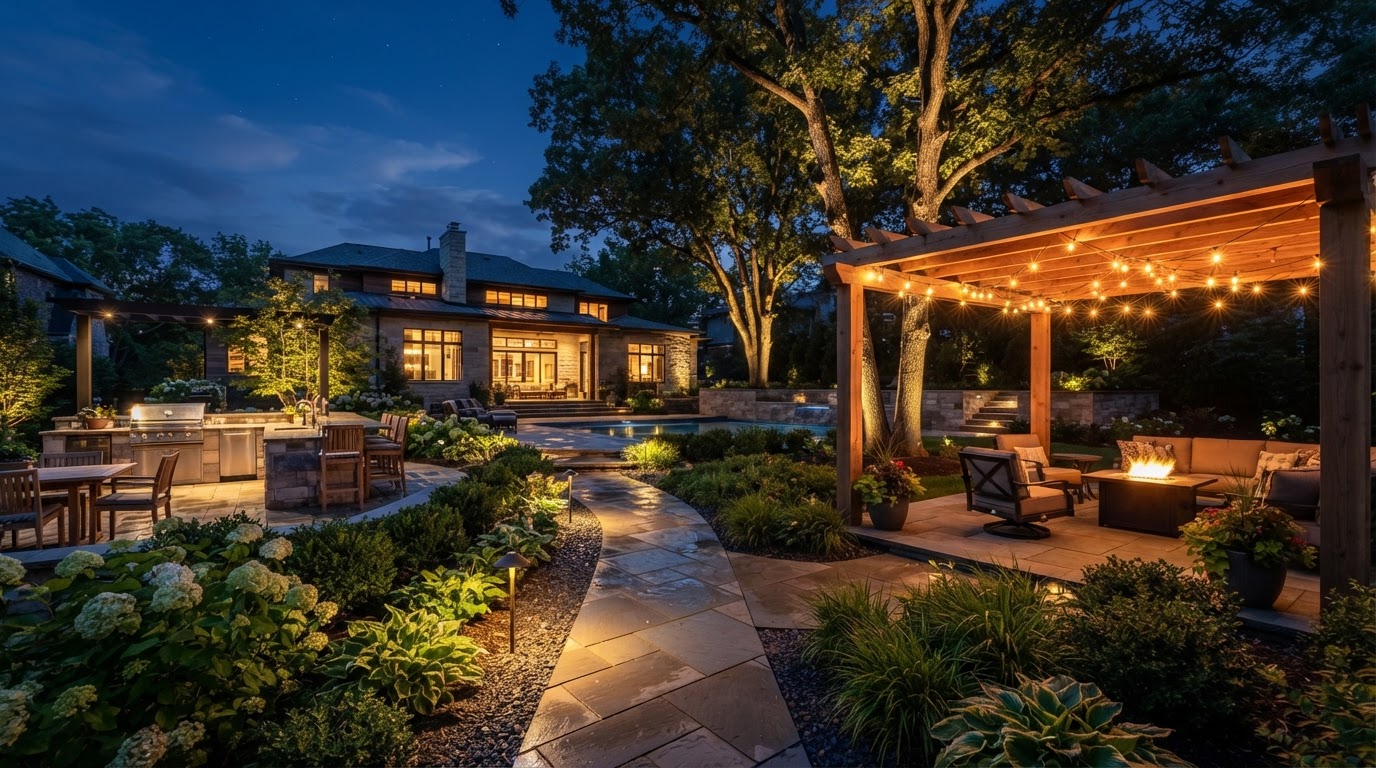
A backyard that looks beautiful during the day disappears at night without the right lighting. Good landscape lighting does not flood the yard with light. It reveals the yard in layers, guiding you along paths, creating mood in gathering areas, and highlighting the features that make the space special. Done well, it makes the yard more usable after dark than during the day.
Designing a lighting plan means thinking in layers before you think about fixtures. Each layer has a job, and the layers work together. When you plan the layers first and the fixtures second, the yard feels designed. When you start with fixtures and hope for the best, you get bright spots, dark gaps, and a yard that feels either overlit or unsafe.
What Are the Layers of Backyard Lighting?
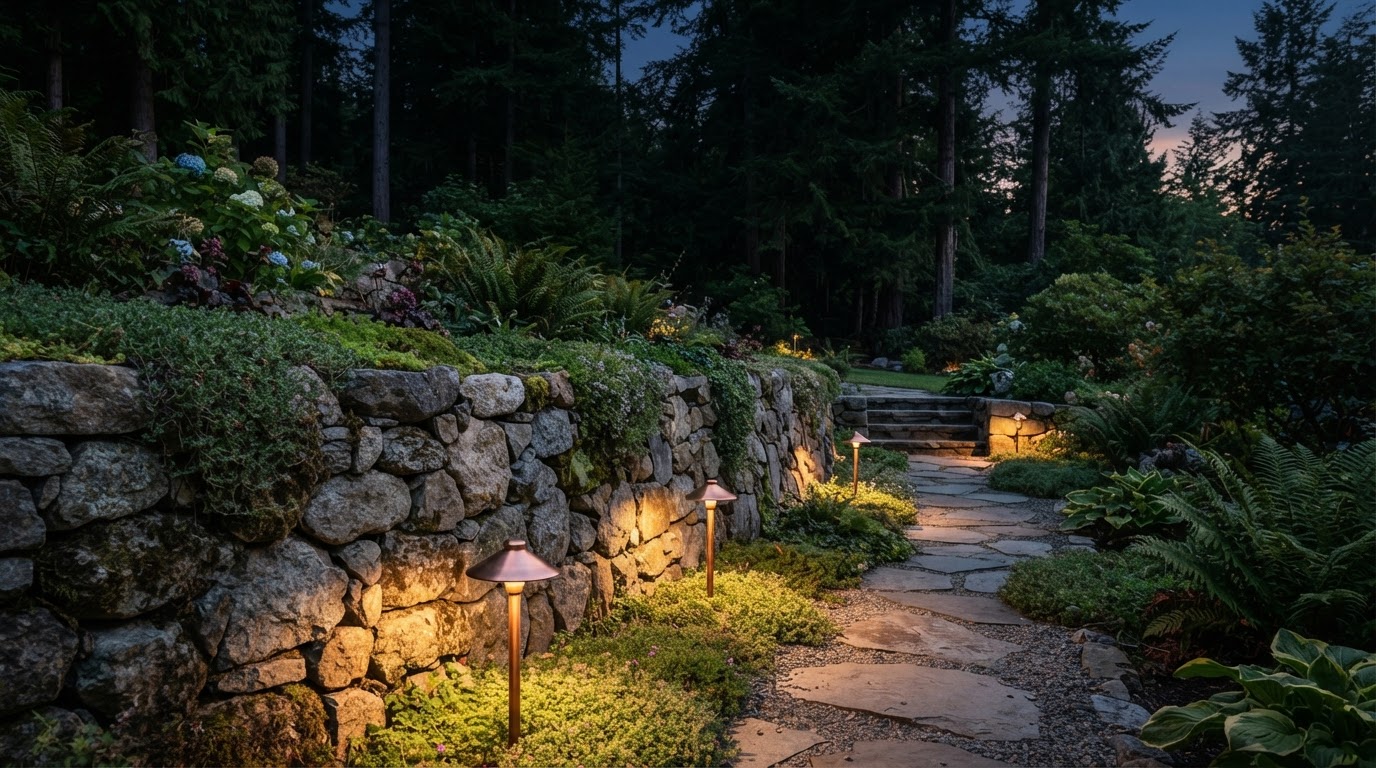
The first layer is path and safety lighting. This is the low path lights that mark walkways, steps, and grade changes. The job is not to flood the path with light but to show the edge so people can walk without tripping. Path lights sit low, 18 to 24 inches, and cast a soft pool of light that shows the route.
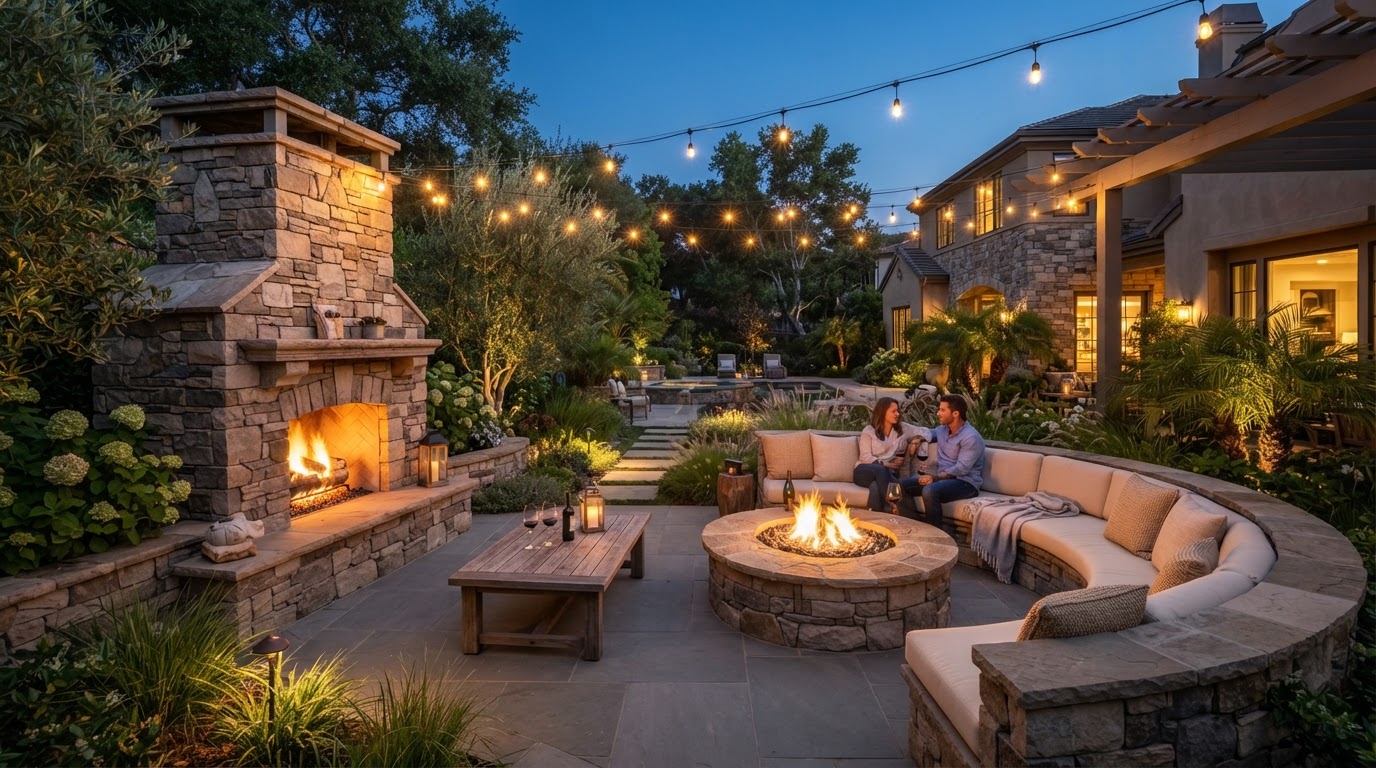
The second layer is ambient lighting. This is the lighting in gathering areas, the string lights over a patio, the post lights on a deck, the low fixtures that create a warm glow where people sit. The job is mood, not task. The third layer is accent lighting. This is the uplighting on a specimen tree, the grazing on a stone wall, the spotlight on a water feature. The job is to show the best features of the yard and give it depth at night.
How Do You Light a Patio or Dining Area?
A patio needs enough light to eat and socialize but not so much that it feels like a parking lot. String lights overhead create a warm, festive glow without harsh shadows. A pendant over a dining table gives focused task light. Low path lights around the edge mark the boundary without lighting the whole space.
Avoid the temptation to put a bright flood light on the patio. It kills the mood and makes the space feel like a commercial building. Use multiple low-level sources instead of one bright one. The light should come from different directions, not one big fixture. Layered, low light feels designed. One bright light feels like a security camera.
How Do You Light Trees and Landscape Features?
Uplighting is the most dramatic technique for trees. A fixture at the base of a tree aimed upward shows the trunk and the canopy, creating a column of light that gives the yard vertical dimension. Choose specimen trees with interesting bark or branch structure. A tree with no character lit from below is just a bright blob.
Grazing means placing a fixture close to a wall, fence, or hedge and washing the surface with light. It shows texture and creates a backdrop. Moonlighting means placing a fixture high in a tree and aiming it down through the branches, casting shadows that mimic natural moonlight. Each technique has a purpose. Use the right one for the effect you want.
What Fixtures Should You Use?
Use brass or copper fixtures for permanent installations. They last decades and develop a patina that blends with the landscape. Aluminum is cheaper but corrodes, especially near irrigation or in coastal areas. For path lights, choose fixtures with a hood that directs light down, not out. Glare is the enemy of good landscape lighting.
LED is the standard now. Look for integrated LED fixtures with replaceable drivers. The LED itself lasts 50,000 hours or more, but the driver that powers it may fail first. Buy fixtures where the driver is a replaceable component, not part of the whole fixture. The upfront cost is higher but the lifetime cost is lower.
How Do You Control Backyard Lighting?
Use an astronomical timer that adjusts for sunrise and sunset automatically. A fixed clock drifts out of sync with the seasons. An astronomical timer keeps the lights coming on at dusk and off at the right time year-round. For more control, add a photocell so lights only turn on when it is actually dark, not when a timer says it should be.
Smart controls let you dim, zone, and schedule from a phone. This is useful for large yards with multiple areas. You can dim the ambient layer after dinner, turn off the accent layer late at night, and keep the safety layer on all night. Zoning saves energy and extends fixture life by not running everything at full brightness all the time.
How Do You Avoid Light Pollution?
Good landscape lighting stays in your yard. Fixtures should direct light down and onto the feature, not up into the sky or out into your neighbor's windows. Use full-cutoff fixtures that prevent upward light. Shield any fixture that creates glare. The goal is to see the effect of the light, not the source.
Less is genuinely more. A yard with five well-placed fixtures looks designed and intentional. A yard with fifteen fixtures looks like a car lot. Light the key features and let the rest sit in low light. The contrast between lit and unlit areas is what creates the drama. Flooding everything with light kills the effect.
How Do You Maintain Backyard Lighting?
Landscape lighting needs seasonal maintenance. Fixtures get bumped by mowers, buried by mulch, and knocked out of aim by plant growth. Schedule a re-aiming walk twice a year, in spring and fall. Check for buried fixtures, shifted beams, and failed lamps. A system that is never re-aimed drifts out of design within two seasons.
Keep spare lamps and drivers on the shelf. When a fixture fails, the replacement should be on hand, not on a two-week order. The fastest way to keep a yard looking lit is to fix failures immediately. A yard with three dark fixtures looks neglected. A yard where every fixture works looks maintained and intentional.
Frequently Asked Questions
How much does backyard lighting cost?
A professionally designed and installed landscape lighting system for a typical backyard ranges from a few thousand dollars for a basic path and accent system to tens of thousands for a large property with multiple zones, high-end fixtures, and smart controls. The fixture quality, the number of zones, and the complexity of the wire runs drive the cost.
Can I add landscape lighting to an existing yard?
Yes, but it is more disruptive than wiring during construction. Trenching through existing landscape damages hardscape and plantings. Low-voltage systems are easier to retrofit because the wire can often be run along surfaces or shallow trenched. Plan the runs to minimize damage to mature plants and hardscape.
What color temperature is best for backyard lighting?
2700K to 3000K warm white is the standard for residential landscape lighting. It looks natural and inviting. 4000K and higher looks institutional and cold. Keep the color temperature consistent across the yard for a unified look.
Do I need a permit for landscape lighting?
Usually not for low-voltage landscape lighting. Hardwired 120V systems may require a permit depending on local code. If you are running new circuits to the yard, an electrician and a permit are typically required.
How long do landscape lighting fixtures last?
Quality brass or copper fixtures last 20 years or more. The LED inside lasts 50,000 hours, roughly 15 years of nighttime use. The driver that powers the LED may fail before the LED itself. Buy fixtures with replaceable drivers so you do not have to replace the entire fixture when the driver dies.
Keep Reading
Plan your project
Use the Project Planner to get a plan outline for your project type, with steps and questions to ask.
Start Your Plan