
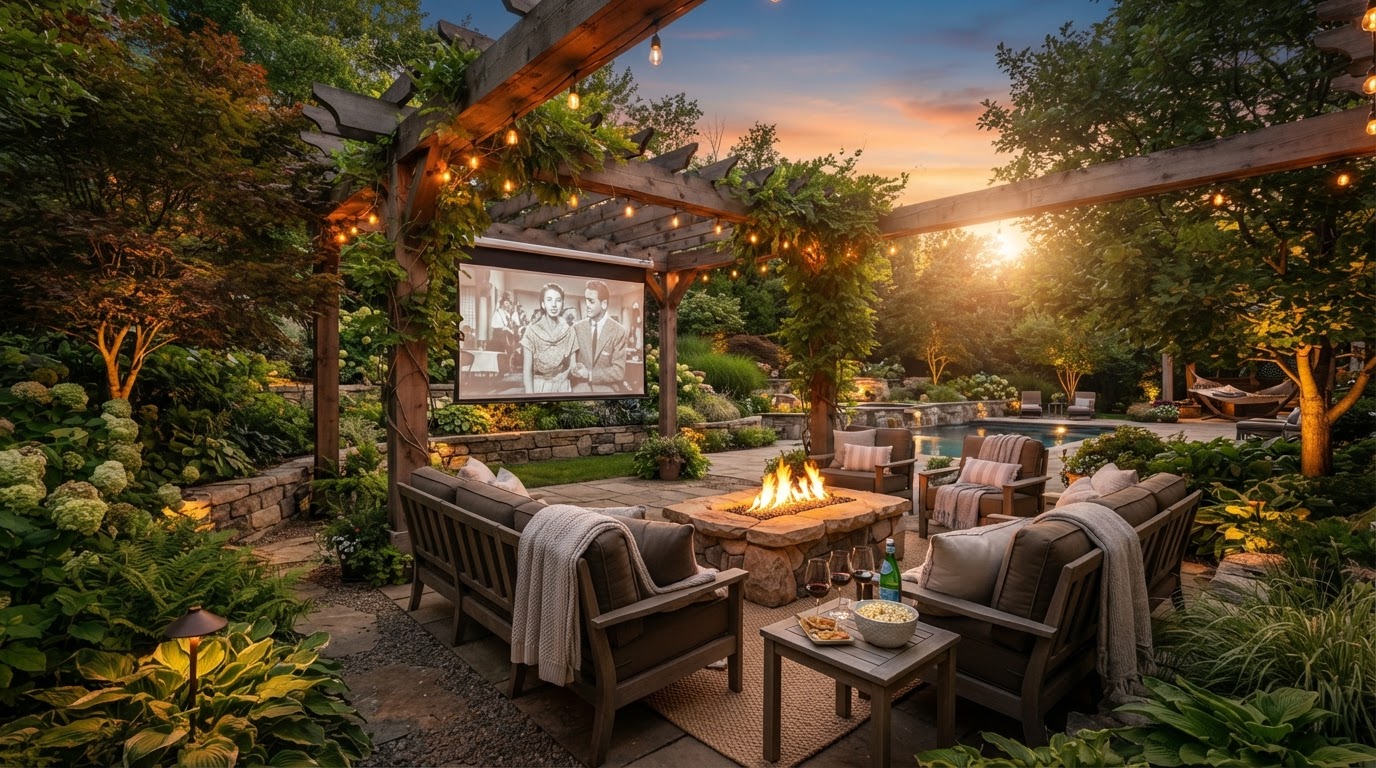
How to Design an Outdoor Movie Night Setup in Your Backyard
An outdoor movie night is the project that turns your backyard into the neighborhood's favorite spot on a summer evening. Here is how to plan one that actually works.
Key Takeaways
- An outdoor movie night needs three things to work: a screen or wall that is large enough and flat enough, a projector bright enough for outdoor use, and a sound system loud enough to hear over the open air.
- The screen placement is the first decision, because the screen determines where the seating goes, where the projector goes, and where the power needs to reach, and the screen that is placed without thinking through the rest is the screen that creates problems down the line.
- Seating is what separates a movie night that feels like an event from one that feels like a camping afterthought, because the seating that is comfortable, arranged in rows or clusters, and lit with ambient light is the seating that makes people stay for the whole movie.
- The power and the weatherproofing are the details that most people skip and that make the difference between a setup that lasts for years and one that breaks after the first rain.
What Do You Need for an Outdoor Movie Night?
An outdoor movie night is not as simple as carrying a TV outside, because the outdoor space does not have the walls that contain the sound, the darkness that makes the screen visible, or the power outlets that a living room has. The setup needs a screen large enough to see from the seating distance, a projector bright enough to compete with any ambient light, a sound system that carries across the open air, and the power to run all three without an extension cord that is a tripping hazard. The movie night that has all four is the movie night that works, and the movie night that has three of the four is the movie night that the guests tolerate but do not enjoy.
The four pieces are the screen, the projector, the sound, and the power, and each one has a set of choices that range from temporary to permanent. The temporary setup uses a portable projector, a pop-up screen or a blank wall, a Bluetooth speaker, and an outdoor-rated extension cord. The permanent setup uses a fixed screen mounted to a wall or a pergola, a projector in a weatherproof enclosure, outdoor speakers wired to an amplifier, and a dedicated outdoor outlet. The temporary setup is the setup that costs less and lasts one season, and the permanent setup is the setup that costs more and lasts for years, and the right choice depends on how often the movie night happens.
Where Should the Screen Go in the Yard?
The screen placement is the first decision because everything else follows from it. The screen needs a flat surface that is large enough for the image, a clear line of sight from the seating area, and a location that is dark enough at night for the projector to produce a visible image. The wall of the house, the back of a pergola, or a freestanding screen on the patio are the common options, and the screen that faces away from the street lights and the neighbor's porch lights is the screen that produces the best image, because the ambient light is the enemy of the projector, and the projector that is fighting ambient light is the projector that produces a washed-out image no matter how bright it is.
The screen also needs to be far enough from the seating that the image is comfortable to watch and close enough that it feels like a movie, not a billboard. The rule of thumb is that the seating distance should be about one and a half to two times the screen width, so a 100-inch screen is comfortable from about 12 to 16 feet away. The seating that is too close is the seating that makes the audience look left and right to follow the action, and the seating that is too far is the seating that makes the movie feel small and the sound feel distant.
How Do You Choose a Projector for Outdoor Use?
The projector for outdoor use needs to be bright enough to produce a visible image in the ambient light of a backyard, because the backyard that has any ambient light, whether from the house, the street, or the landscape lighting, is the backyard that washes out a dim projector. The brightness is measured in lumens, and the projector that is rated at 2,000 lumens is the projector that works in a fully dark backyard, and the projector that is rated at 3,000 lumens or more is the projector that works in a backyard with some ambient light. The projector that is too dim is the projector that produces an image the audience cannot see, and the brightness is the spec that matters most for outdoor use.
The projector also needs to be rated for outdoor use or housed in a weatherproof enclosure, because the projector that is left outside is the projector that gets ruined by the first rain. The portable projector that is brought outside for the movie and stored inside afterward is the projector that lasts, and the permanent projector that is mounted outside is the projector that needs the enclosure, the ventilation, and the weatherproofing that protect it from the elements. The projector that is protected is the projector that lasts, and the projector that is not is the projector that breaks after the first season.
What Sound System Works Best Outdoors?
The sound system for an outdoor movie needs to be louder than the indoor system, because the open air does not contain the sound the way walls do, and the sound that fills a living room is the sound that disappears in a backyard. The Bluetooth speaker that works for background music is the speaker that does not work for a movie, because the movie needs the dialogue to be clear and the soundtrack to be full, and the speaker that is too small is the speaker that produces tinny sound that makes the audience strain to hear. The sound system that works is the system with a speaker large enough to produce the full range, positioned between the screen and the seating, and aimed at the audience, not at the house.
The permanent outdoor sound system uses weather-rated speakers mounted to a wall or a pergola and wired to an amplifier inside, and the system is the one that produces the best sound and lasts the longest. The temporary system uses a portable Bluetooth speaker or a soundbar placed near the screen, and the system is the one that works for the first movie night and gets upgraded when the family decides the movie night is a regular event. Both work, and the right choice is the one that matches how often the movie night happens.
How Do You Power Everything Safely?
The power for the outdoor movie night is the detail that most people underestimate, because the projector, the sound system, and any lighting all need power, and the power that comes from an indoor outlet through an extension cord is the power that needs to be outdoor-rated, grounded, and protected from the weather. The extension cord that is indoor-rated is the extension cord that is not safe outdoors, and the cord that is too thin is the cord that overheats when the projector and the speaker both draw power through it. The outdoor-rated cord that is thick enough for the load and routed where no one trips over it is the cord that powers the movie night safely, and the cord that is not is the cord that is a hazard.
The permanent setup uses a dedicated outdoor outlet installed by an electrician, and the outlet is the one that is grounded, weatherproof, and rated for the load. The temporary setup uses an outdoor-rated extension cord from an indoor outlet, and the cord is the one that is run through a door or a window and kept dry. The power that is done right is the power that runs the movie night without a thought, and the power that is done wrong is the power that trips the breaker or, worse, creates a hazard that no movie is worth.
Frequently Asked Questions
Can I use any projector outdoors?
Any projector can be used outdoors temporarily, but the projector that is left outside needs to be rated for outdoor use or housed in a weatherproof enclosure. The portable projector that is brought out for the movie and stored inside afterward works fine, and the permanent projector that is mounted outside needs the enclosure, the ventilation, and the protection that keep it dry. The projector that is not protected from the weather is the projector that breaks after the first rain, and the projector that is brought inside is the projector that lasts as long as the indoor projector does.
How big does the screen need to be?
The screen needs to be large enough to see from the seating distance, and the seating distance is about one and a half to two times the screen width. A 100-inch screen is comfortable from 12 to 16 feet away, and a 120-inch screen is comfortable from 15 to 20 feet. The screen that is too small for the seating distance is the screen that makes the movie feel small, and the screen that is too large is the screen that makes the audience look back and forth. The right size is the one that fills the field of view without overwhelming it, and the size depends on the yard and the seating, not on the biggest screen available.
Do I need a sound system or will my phone speaker work?
A phone speaker does not work for an outdoor movie, because the open air does not contain the sound the way a room does, and the speaker that is loud enough indoors is the speaker that disappears outdoors. The movie needs the dialogue to be clear and the soundtrack to be full, and the speaker that produces that is a speaker with enough size and power to fill the outdoor space. A Bluetooth speaker with a subwoofer works for a small patio, and a pair of outdoor speakers wired to an amplifier works for a larger yard. The sound system that is too small is the sound system that makes the audience strain to hear, and the system that is right is the system that the audience does not think about because it sounds natural.
What is the best surface for the screen?
The best surface for the screen is a flat, white or light-colored wall or a dedicated projector screen, because the surface that is smooth and light-reflecting is the surface that produces the clearest image. A white stucco wall works, a smooth fence panel painted white works, and a pop-up or fixed projector screen works best. The surface that is textured, dark, or uneven is the surface that distorts the image, and the surface that is smooth and light is the surface that produces a picture that looks like a movie, not a shadow on a wall.
How much does a permanent outdoor movie setup cost?
The cost of a permanent outdoor movie setup depends on the screen, the projector, the sound system, the power, and the installation, and the range is wide because the quality of each piece varies. The temporary setup of a portable projector, a pop-up screen, and a Bluetooth speaker is the setup that costs the least, and the permanent setup of a fixed screen, an enclosed projector, outdoor speakers, and a dedicated outlet is the setup that costs the most. The cost is driven by the quality of the components and the permanence of the installation, and the setup that matches how often the movie night happens is the setup that costs the right amount.
Keep Reading
Plan your project
Use the Project Planner to get a plan outline for your project type, with steps and questions to ask.
Start Your Plan