
How to Plan Commercial Grounds for Year-Round Interest and Low Maintenance
Commercial grounds that look good in every season take planning. Here is how to choose plants and structure your landscape so the property never looks empty, no matter the month.
Key Takeaways
- Year-round interest means choosing plants that look good in every season, not just spring and summer.
- Structure is the backbone. Evergreens, hardscape, and woody plants carry the landscape when perennials are dormant.
- Plan for four layers of interest: evergreen structure, seasonal bloom, fall color, and winter texture.
- Low maintenance and year-round interest work together. The right plant choices reduce pruning, watering, and replacement.
How to Plan Commercial Grounds for Year-Round Interest and Low Maintenance?
Commercial grounds that look good in July but empty in January are not finished landscapes. They are landscapes with a three-month shelf life. Year-round interest means designing the grounds so there is something worth looking at in every season, not just when the perennials are blooming. It is the difference between a property that always looks maintained and one that looks abandoned half the year.
Planning for year-round interest means thinking in layers. The structure layer carries the landscape when nothing is blooming. The seasonal layer adds color and change. The maintenance layer keeps it all manageable without a full-time gardener. When the layers work together, the property looks intentional in January and in July.
What Is the Structure Layer?
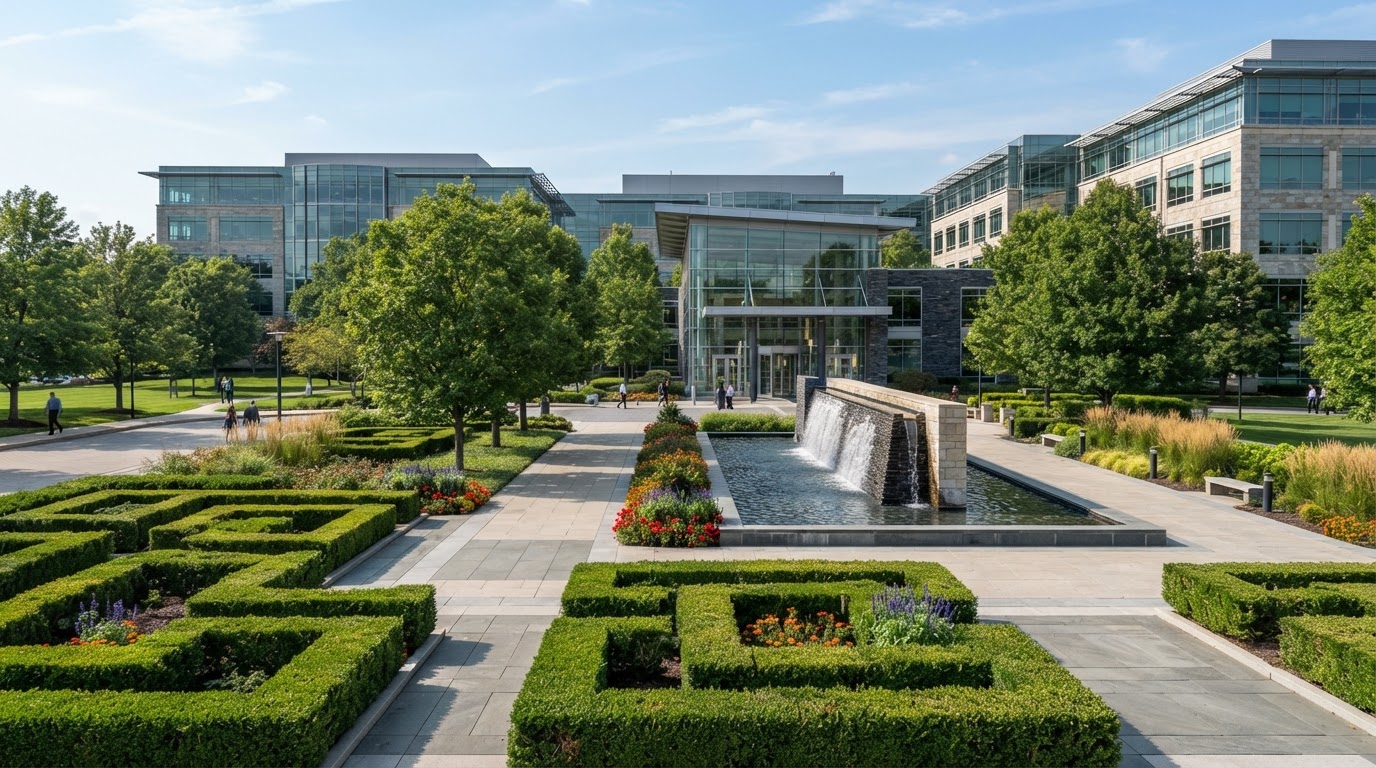
The structure layer is the evergreen and woody plant framework that holds the landscape together when perennials die back. Boxwood hedges, evergreen shrubs, ornamental grasses left standing through winter, and the hardscape itself are all structure. This is what the landscape looks like stripped of seasonal color. If the structure layer is weak, the landscape falls apart in November.
Structure does not mean boring. A well-placed row of boxwood creates rhythm and form. A cluster of evergreen hollies provides winter berries and shelter for birds. Ornamental grasses left standing through winter catch frost and create movement. The structure layer is the backbone that everything else hangs on, and it is the layer most commercial landscapes underinvest in.
How Do You Plan for Four Seasons of Interest?
Spring is easy. Every plant blooms in spring. The challenge is the other three seasons. Summer needs plants that hold up to heat without constant watering. Choose drought-tolerant perennials and deep-rooted shrubs that do not wilt in August. Summer is also when the landscape gets the most use, so it needs to look good when people are actually outside looking at it.
Fall needs plants that change color or produce fruit. Maples, oaks, and viburnums provide fall color. Winterberry hollies hold red berries through December. Ornamental grasses turn gold and catch the low winter light. Winter needs plants with interesting bark, structure, or evergreen foliage. Without winter interest, the property looks dead for four months. With it, the property looks like a designed landscape year-round.
How Do You Choose Plants for Low Maintenance?
Low maintenance starts with the right plant in the right place. A plant that is suited to your climate, soil, and sun exposure needs less water, less pruning, and less replacement. A plant fighting its environment needs constant intervention. Choose natives and adapted species that thrive without help in your region.
Size matters. A plant that grows to its mature size without pruning is low maintenance. A plant that has to be sheared to stay smaller than it wants to be is high maintenance. Know the mature size before you plant, and space accordingly. Overplanting leads to crowding, disease, and the need for constant pruning. Underplanting leaves gaps that weeds fill.
What Role Does Hardscape Play in Year-Round Interest?
Hardscape is the permanent structure that never goes dormant. Stone walls, pathways, patios, and water features provide visual interest 12 months a year. When the plants are bare, the hardscape carries the design. A landscape with strong hardscape and modest planting looks intentional all year. A landscape with weak hardscape and ambitious planting looks empty in winter.
Hardscape also reduces maintenance. Stone and gravel do not need watering, pruning, or pest control. A landscape that leans on hardscape for structure and uses plants for accent, rather than the other way around, costs less to maintain and looks better in every season. The balance between hardscape and softscape is the most important design decision for a commercial property.
How Do You Manage Irrigation for Year-Round Health?
Irrigation is what keeps the landscape alive through the seasons, but it has to be managed. Over-watering kills more commercial landscapes than under-watering. Roots that sit in saturated soil rot. A smart controller with a rain sensor and seasonal adjustment prevents the most common irrigation problems.
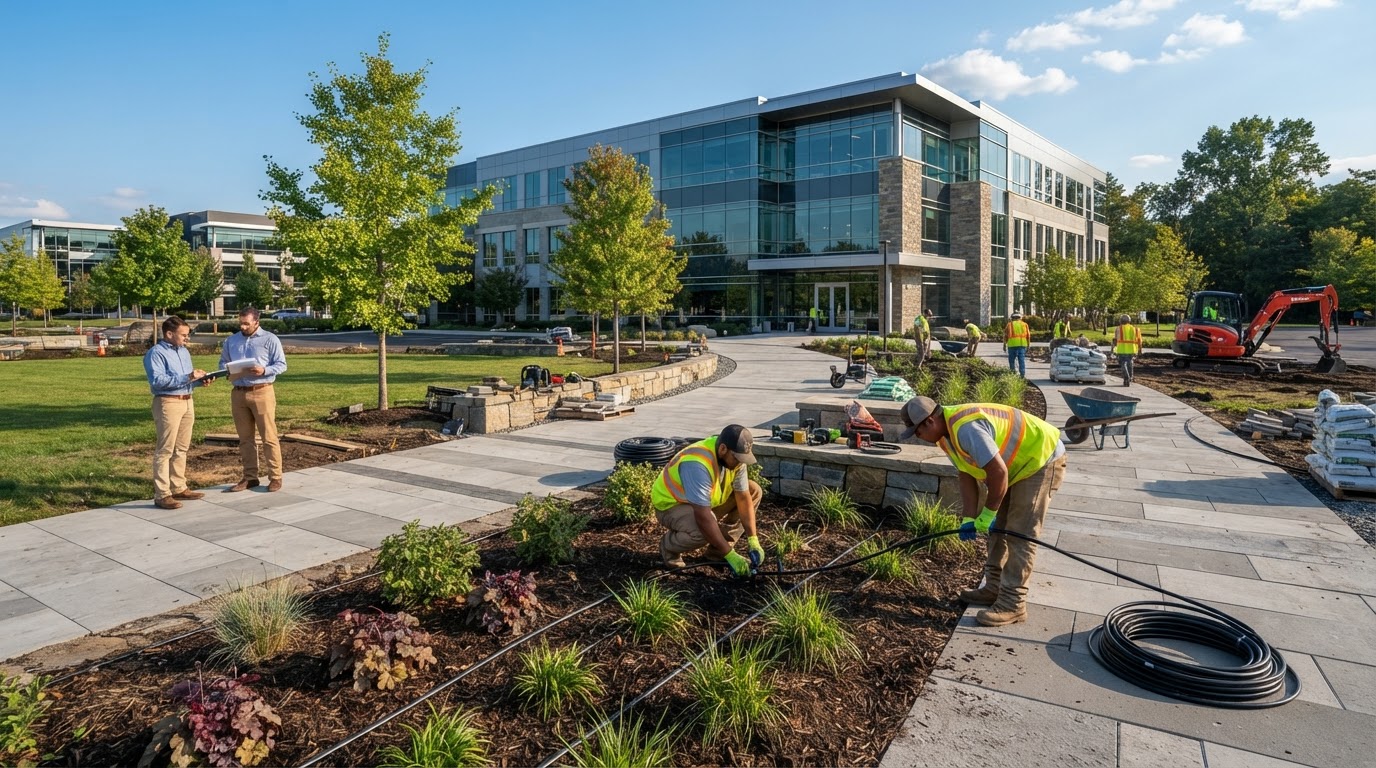
Plan irrigation zones by plant type, not by area. Trees need deep, infrequent watering. Perennials need shallower, more frequent watering. Lawns need regular coverage. When all three are on the same zone, something gets too much or too little. Separate zones by plant type so each gets what it needs without wasting water on the others.
How Do You Handle Seasonal Transitions?
Seasonal transitions are when maintenance peaks. Spring cleanup removes winter debris, cuts back perennials, and mulches beds. Summer is about watering and pest monitoring. Fall is leaf removal, cutting back perennials, and winterizing irrigation. Winter is pruning dormant trees and shrubs and protecting vulnerable plants from freeze.
Each transition is a scheduled event, not a reaction. A maintenance calendar that maps the transitions prevents the chaos of responding to problems after they appear. The best-maintained commercial properties are the ones where the maintenance team knows what happens each month before the month arrives, not after the property starts looking rough.
How Do You Budget for Year-Round Maintenance?
A year-round landscape costs more to maintain than a seasonal one, but the cost is predictable. Budget for monthly maintenance, seasonal cleanups, irrigation management, and a replacement reserve. Plants die, hardscape cracks, and irrigation heads break. A reserve fund for replacements prevents the landscape from declining year over year.
The biggest budget mistake is underfunding maintenance. A landscape designed for year-round interest but maintained on a bare-minimum budget will deteriorate. Budget for the level of care the design requires, or simplify the design to match the budget. A simple, well-maintained landscape looks better than a complex, neglected one.
Frequently Asked Questions
What plants provide winter interest in commercial landscapes?
Evergreen shrubs like boxwood and holly, ornamental grasses left standing, plants with interesting bark like river birch, and plants with winter berries like winterberry hollies. Structure is more important than flowers for winter interest.
How often should commercial grounds be maintained?
Weekly during the growing season for lawns and high-visibility areas. Biweekly for beds and lower-traffic zones. Monthly minimum for all areas. Seasonal cleanups four times a year. The frequency depends on the property type and the level of design.
Can you have year-round interest with native plants only?
Yes, and native plants often provide better year-round interest because they are adapted to local seasonal cycles. Native evergreens, grasses, and berry-producing shrubs are designed by evolution to look good in your climate year-round.
How do you reduce watering costs on commercial grounds?
Use drought-tolerant plants, group plants by water needs, install smart irrigation controllers with rain sensors, and reduce lawn area in favor of mulched beds. Drip irrigation for beds uses a fraction of the water that spray heads use.
What is the biggest mistake in commercial landscape design?
Designing for spring bloom only. A landscape that looks great in May and empty in November is not finished. The best commercial landscapes are designed for December, when everything is stripped to its structure, because if the structure works in winter, the rest of the year is easy.
Keep Reading
Plan your project
Use the Project Planner to get a plan outline for your project type, with steps and questions to ask.
Start Your Plan